Should you rake leaves off the lawn?
Yes, off the lawn, but not off the borders. A layer of wet leaves left over winter shuts out the light, keeps the grass damp and gives snow mould exactly what it needs, so in spring the grass comes up yellow and patchy. Rake while the leaves are falling, and one last time when the trees are bare. Where winter brings lasting snow, that last time is before the snow settles. Where it does not, it is whenever the last leaves are down, even on a mild day in December.
Gardian is a Swedish garden app, and in much of Sweden the lawn spends months under snow, so the deadline here is set by the snow, not the calendar. If your winters are mild and wet, the deadline is softer but the damage is the same. Rain does to a mat of leaves what snow does, only more slowly.
Where snow comes and goes several times over the winter, as it does across southern Scandinavia and much of northern Europe, it pays to rake up the last leaves on a dry day between snowfalls.
What happens if the leaves stay?
Grass keeps growing as long as the soil stays above freezing, and it needs light to get through the winter. Under a dense layer of leaves it gets none. The blades yellow, the plants weaken, and in spring they stand thin.
The fungus is worse. Snow mould thrives between 0 and 8 °C (32 and 46 °F) in damp, still air, and a wet layer of leaves under snow gives it all three. You see it when the snow melts: round patches, white or pink at the edge, where the grass lies matted and dead. In mild, wet winters without snow the same fungus, Microdochium nivale, causes fusarium patch, and a layer of leaves helps it just as much. The patches heal slowly, and moss is happy to move in where the grass has weakened. Why moss wins in exactly those places is in the article on moss in the lawn.
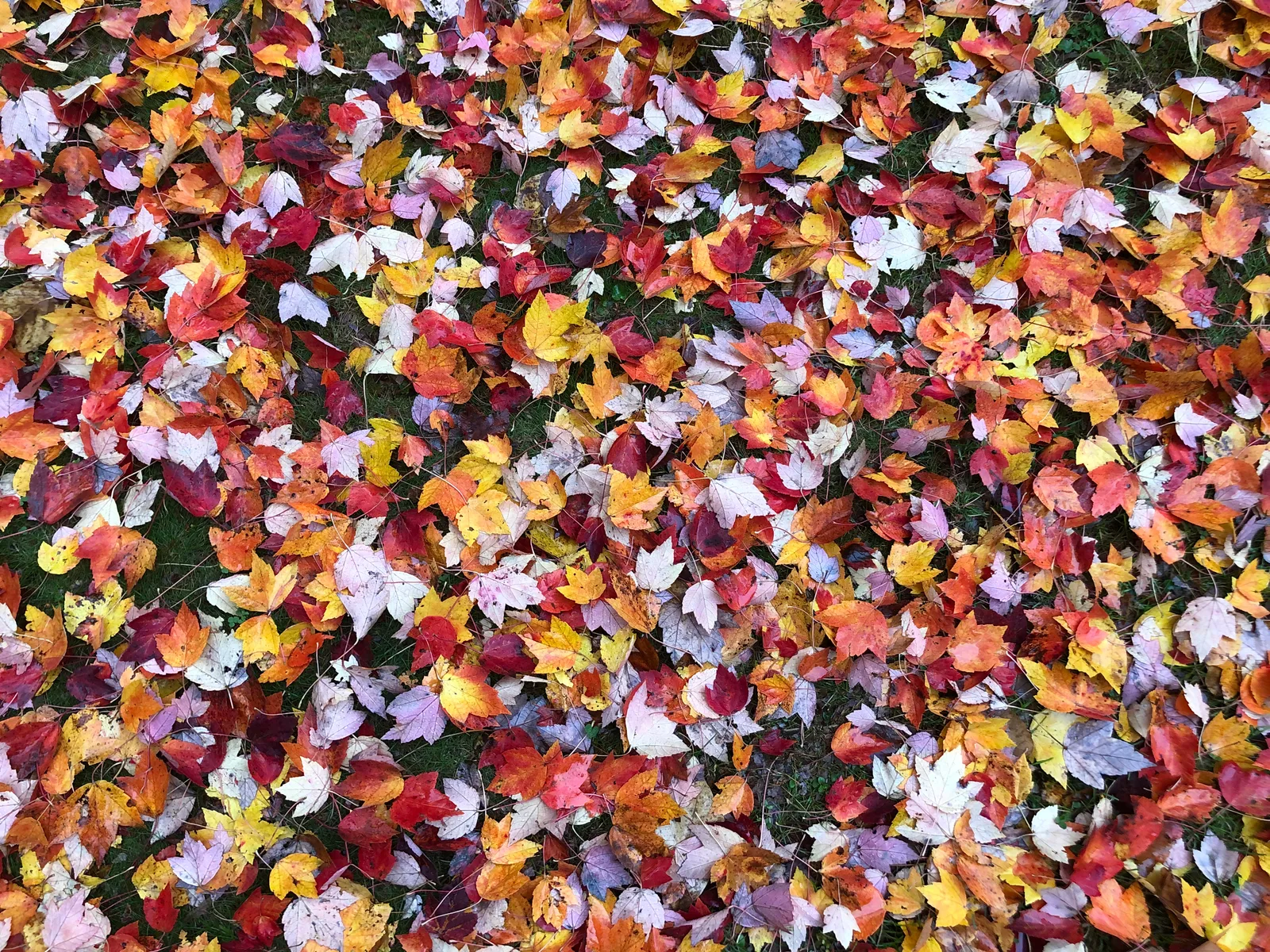
A thin scatter of dry leaves here and there does no harm. It is the dense, wet layer that smothers, and it builds up fast under a maple or an oak. Look at the grass: if you can see green between the leaves, another week is fine. If all you see is leaves, it is time.
How often should you rake?
Little and often beats once and big. Dry leaves that have lain for a few days rake up in a quarter of an hour. The same leaves after two weeks of rain have stuck together into a wet mat that weighs twice as much and tears up grass when you drag it. Every weekend while the leaves are falling is a good rhythm.
A thin layer you can run the mower over instead. It shreds the leaves, and the shreds break down in the lawn. That only works while the soil surface stays at about 6 °C (43 °F), because then there is life in the soil to deal with them. Mow over the leaves later in the autumn and the shreds lie there all winter and do the same damage as whole leaves.
Skip: The leaf blower when the leaves are wet. It moves dry leaves well, but wet ones stick, and you end up with a rake anyway.
If the snow came before you got round to it, rake as soon as the lawn has dried out in spring. The grass usually recovers, but patches of snow mould need airing and sometimes reseeding.
Where should the leaves go?
Onto the borders, not into bags. There they protect the roots from frost and break down into soil by next summer, and oak and beech leaves are best because they do not mat. If there are more than the borders need, make a pile in a corner for hedgehogs to winter in, where you have them, or turn the surplus into leaf mould. More on what leaves do in the rest of the garden is in the article on autumn garden jobs.
Sources
- Royal Horticultural Society, Fusarium patch and snow mould. The fungus behind both, and the cool, damp conditions it needs.
- SMHI (Swedish Meteorological and Hydrological Institute), Snötäckets utbredning och varaktighet. In Swedish. When the first lasting snow usually comes across Sweden, and where snow comes and goes all winter.
- Husqvarna, Snömögel. In Swedish. Snow mould thriving between 0 and 8 °C, and leaves and clippings left on the lawn as its breeding ground.
- Husqvarna, Klippa gräset på hösten. In Swedish. The last cut of the autumn, and why leaves and windfalls should be off the lawn before winter.
The advice on how often to rake is based on experience, not on a single source.