Why do you get moss in the lawn, and how do you get rid of it?
The standard advice for moss is to lime the lawn, and on most gardens it is the wrong advice. Moss is not an attack from outside. It moves in where the grass has already given up, and grass gives up for four reasons: too little food, too little light, soil that is too compacted, and mowing too short. Fix none of them and the moss is back within a year, however much you rake out in April.
Gardian is a Swedish garden app, and this advice was worked out where winter arrives in October and the grass stops growing with it. That changes one thing in this article, the timing of the raking out, and in a mild climate the answer is different. Everything else holds anywhere.
Why do you get moss in the lawn?
Grass is demanding. It wants nitrogen in the soil and light on its blades, and when either is missing it grows more slowly. Moss wants almost nothing. It has no roots to speak of, takes up water straight through its leaves and gets by on ground where grass can barely manage. So it rarely outcompetes the grass. It fills in after it.
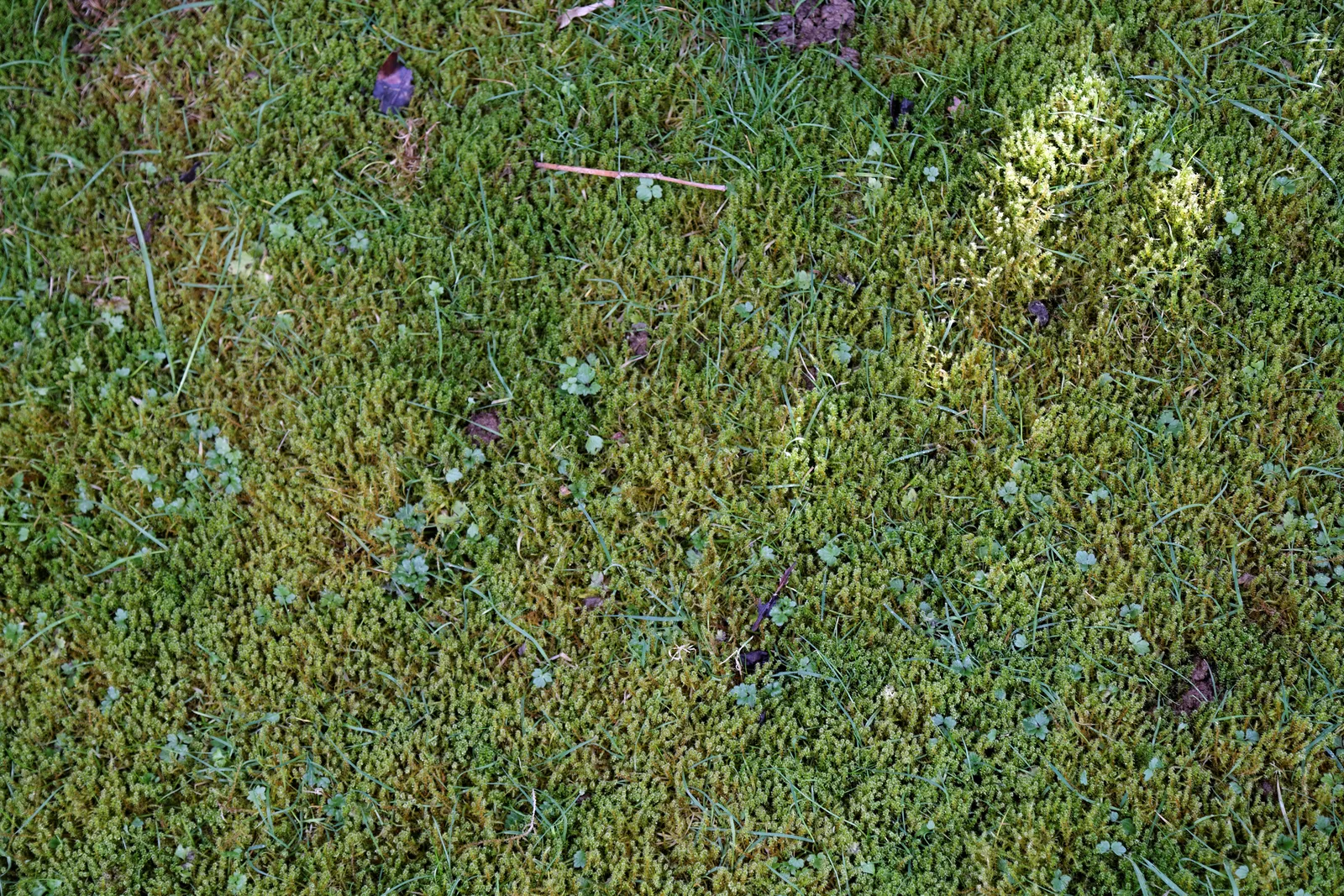
Four causes, and they are far from equally common.
Too little food. Olle Berg, who has written about Swedish lawns since the seventies, puts it at 85 per cent of cases. Take that as a rule of thumb and not as research, but the direction matches what actually happens: feed a mossy lawn properly two seasons running and the moss shrinks without you touching a rake.
Too little light. The grasses in ordinary seed mixes want four to six hours of direct sun. Under a mature apple tree, inside a dense hedge or along the north side of the house they never get it, and there moss is not a problem but the end of the line. A wet layer of leaves left over winter also shuts out the light, and when and how often to rake is in the article on raking leaves off the lawn.
Compacted or wet soil. Grass roots need oxygen, and in trodden-down soil there is none. The moss draws the problem for you if you look at the pattern: the ring round the trampoline, the shortcut between the gate and the front door, the dip where water stands for two days after rain.
Mowing too short. The height of the grass above ground roughly matches the depth of the roots below it, so a lawn kept at two centimetres has roots only in the top layer and is the first thing to dry out in a dry week in July. Short grass also lets sun down onto bare soil between the blades. That is exactly what a moss spore needs.
Tip: Look at the pattern before you buy anything. If the moss is spread evenly over the whole lawn, it is food or mowing height. If it is in patches, it is shade or water, and then you fix the spot instead of the whole lawn.
Does moss mean the soil is acid?
Sometimes. Usually not, and that misunderstanding costs homeowners more weekends than any other in this subject.
Grass thrives between pH 6.0 and 7.0 and starts to lose ground below 5.5. But moss grows perfectly well in neutral soil too, as long as it is shady, wet or hard-packed. Seeing moss and concluding "acid" is guessing one of four causes and then going shopping.
Lime does not kill moss either. Lime raises the pH, the grass has an easier time, and over a couple of seasons the grass can take the ground back. It is a slow change to the playing field, not a treatment.
The amount cannot be guessed. Swedish websites recommend anything from 2 to 60 kilos of garden lime per 100 square metres, which says more about none of them knowing your soil than about what you need. A soil test costs little, takes a couple of weeks and comes back with the pH and a lime dose worked out for your soil type. It is the only route to a number that means anything.
One more thing, repeated in guide after guide and wrong: feeding does not raise the pH. Nitrogen fertiliser with ammonium does the opposite. As the ammonium converts in the soil it releases hydrogen ions and the soil slowly turns more acid. Feed so the grass grows. Not to move the pH.
Skip: Liming by feel. Without a soil test you know neither whether you need it nor how much, and lime on a soil already at 6.5 does nothing at all.
When in the year should you remove moss?
Anything that tears at the turf belongs to a time when the grass is growing hard enough to fill the gaps before anything else does, and that depends on soil temperature more than on the date. Wait until the soil is at 10 °C (50 °F). Then the grass grows visibly and grass seed germinates in a good week instead of three.
The reason to wait is simple. Raking out leaves bare soil, and bare soil belongs to whatever grows fastest at that moment. Do the job when the grass is in full swing and that is the grass. Do it in March and it is the moss and the weed seeds, and you have in effect resown for them.
Where winter comes early, autumn is wrong for the same reason. You kill the moss, leave the soil bare through the whole winter and get it back with company in March. It is worth saying plainly, because moss rakes and moss killers sell hardest in September.
In a mild climate the answer is different. In Britain, lawn specialists scarify in September and early autumn, because the soil stays warm and the grass keeps growing well into November, long enough to cover the bare patches before winter. If your autumns are like that, early autumn works and spring works. If your grass stops growing in October, stick to spring. What does belong to the autumn is in the article on autumn garden jobs.
| Where you garden | When to rake out moss |
|---|---|
| Mild and wet, the grass grows into November | Early autumn (September) or spring, once the soil is at 10 °C |
| Cold winters, the grass stops in October | Spring only: late April to May, once the soil is at 10 °C |
| Long winters | Spring only: late May to early June |
How to rake out the moss
Raking out is a miserable job, and it is the one part of the work you cannot dodge. Dead moss is still a dense, wet mat lying on the soil until someone pulls it off.
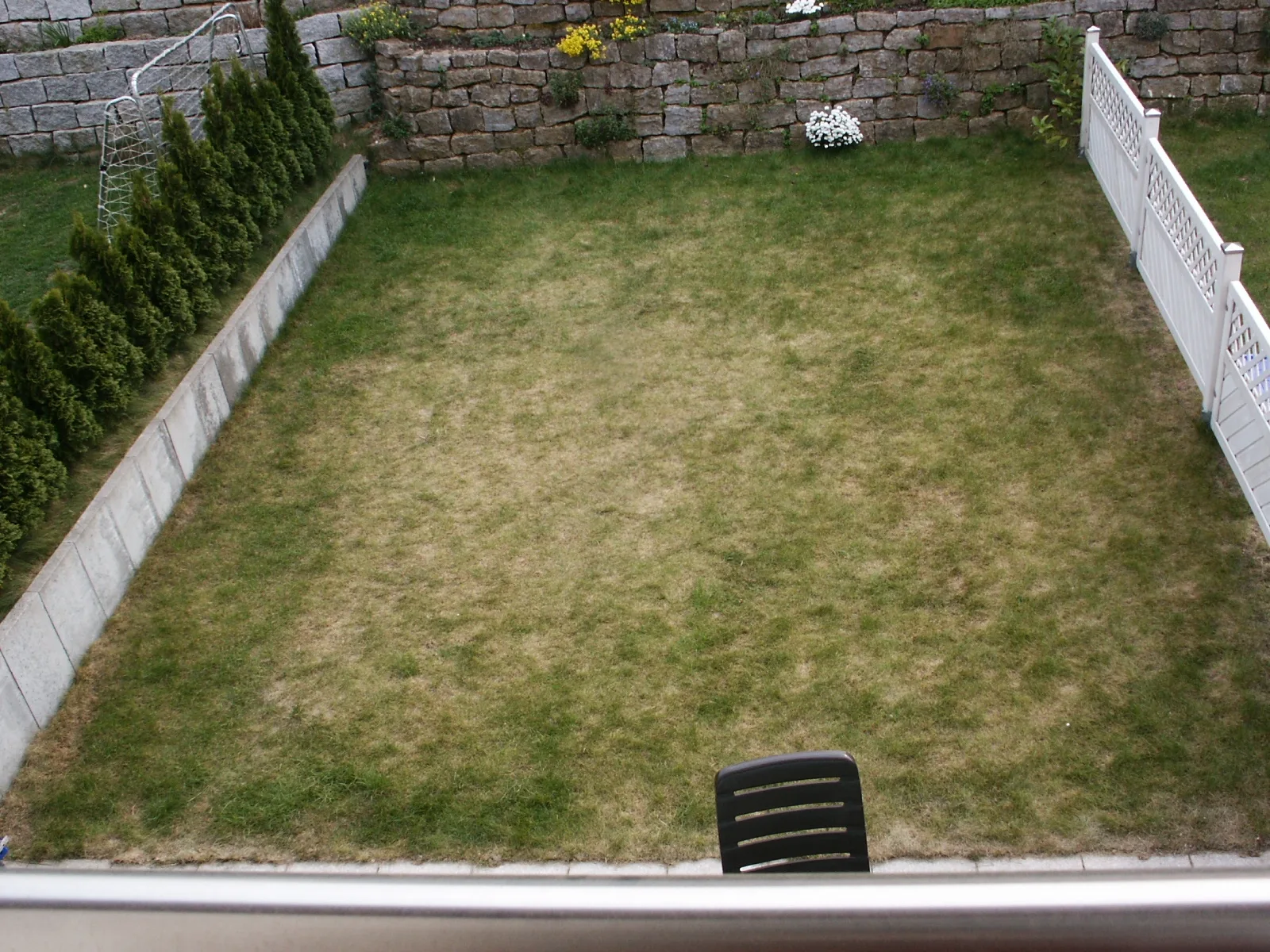
On small areas a spring-tine rake does it, a rake with springy steel tines. Allow an hour per hundred square metres and a sore back. On anything over a couple of hundred square metres, hire a scarifier instead, petrol-powered if you can choose, and set the blades to go 1 to 2 centimetres down. Deeper than that and you tear the turf apart instead of airing it.
The amount surprises everyone. An ordinary mossy lawn of 600 square metres gives about ten full bags, which is more than fits in an ordinary car and far more than a garden waste bin holds. Lay out a tarpaulin before you start and drive straight to the tip.
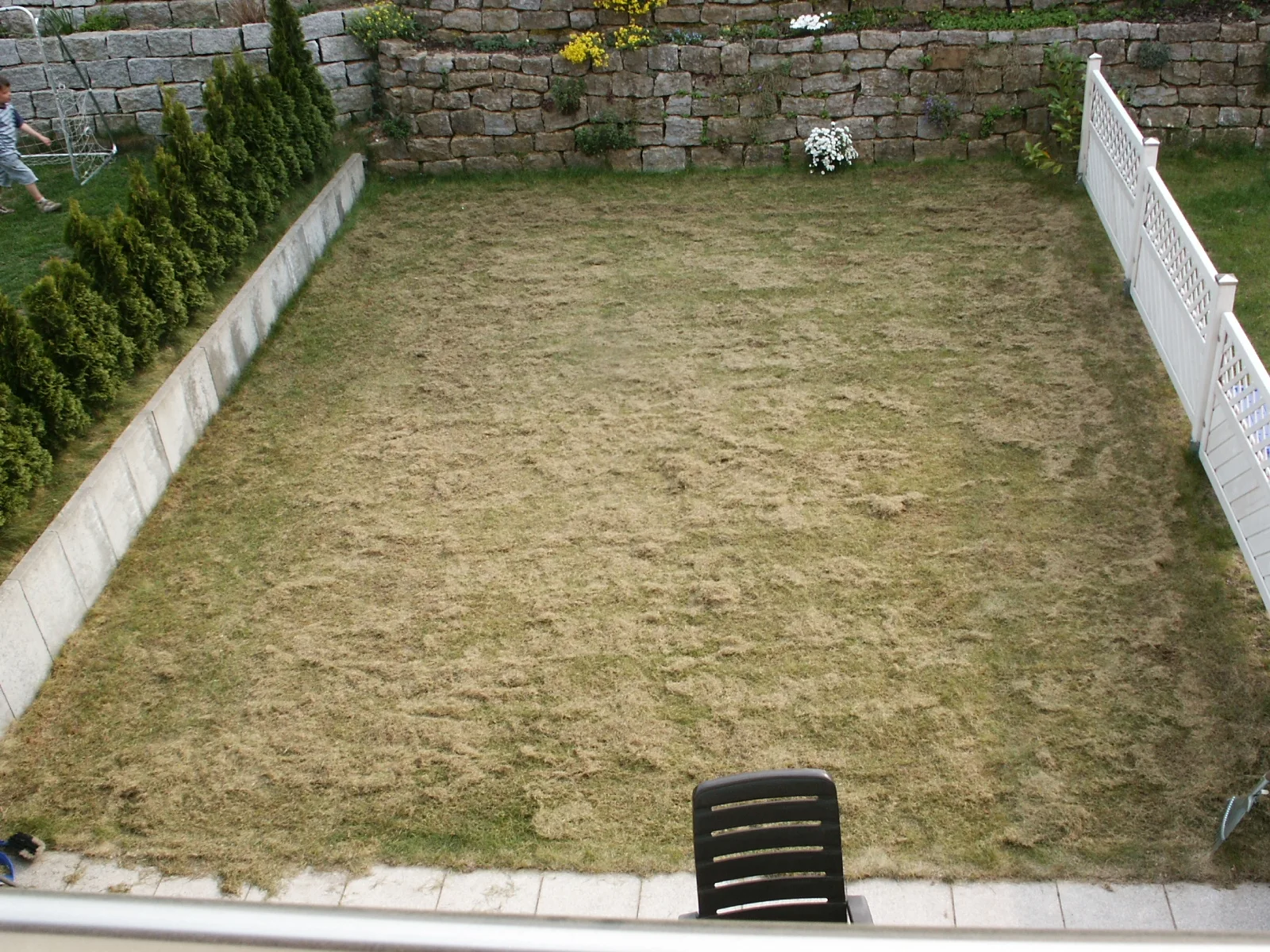
After raking the lawn looks ruined. Brown, ragged, full of holes and much worse than the mossy carpet you had in the morning. That phase lasts three weeks if you do the rest the same day, and it is in that phase people lose heart and stop watering, which is exactly what decides whether the job was wasted.
| Step | When | What it does |
|---|---|---|
| Rake out the moss | Soil at 10 °C, see the table above | Bare soil the grass can germinate in |
| Top-dress the gaps | Same day | 1 to 2 centimetres of top dressing or topsoil levels out and keeps the seed moist |
| Overseed | Same day | 1 kilo of seed covers 40 to 50 square metres |
| Feed | Same day | 3 kilos of slow-release lawn feed per 100 square metres |
| Water | Three weeks on | Newly sown seed that dries out for a single day never germinates |
Does iron sulphate work on moss?
On the moss, yes. On the cause, no.
Iron sulphate (ferrous sulphate) blackens the moss in two to three days and does nothing to the grass. Dissolve 100 to 200 grams in 10 litres of water and water it over about 50 square metres, or spread 2 decilitres of powder over 15 square metres if you apply it dry. If you go dry, mix the powder with an equal amount of dry sand first. It is the only way to get it even, and uneven spreading shows all summer as dark stripes.
What you are allowed to use differs by country. In Sweden most garden pesticides were banned on home gardens in October 2021, and iron sulphate moss killer is one of the few low-risk products a private gardener may still use. In Britain it is sold in every garden centre as lawn sand and moss killer. Check what applies where you live.
Warning: Iron sulphate stains concrete, paving and timber decking rust brown, and the stains do not come out. Never rinse the tools on the paving, and keep a couple of spade widths' margin from the path when you spread it.
Then you are standing there with the rake anyway. Black moss is as dense as green moss, and grass seed does not germinate through it.
The grass never wins under the spruce
There are places where nothing in this article helps. Under a mature spruce, inside a dense thuja hedge, along a north wall with two metres to the fence. There it is not about food or pH but about no light getting in, and then there are three honest ways forward.
Resow with a shade mix. These contain red fescue, hard fescue and rough meadow-grass instead of the sun-loving kinds, and a kilo covers 40 to 50 square metres. At the same time raise the mowing height to 6 centimetres on that patch, so the blades have more area to catch what little light there is.
Let the light in instead. Lifting the crown, taking off the lowest tiers of branches, gives several hours more light a day on the ground beneath. Under an apple tree that is often the whole difference. Under a spruce it rarely is.
Or stop. It is the one place in a garden where I think you should give up on purpose and replace the grass with something that actually wants to grow there: ivy, periwinkle, ferns, or just bark and a bench. A carpet of moss left in peace is also green in August, when the lawn round it is yellow.
How to keep the moss away
Feeding is the single most important thing, and it should come three times: when the grass has really started growing in spring, around midsummer, and in late summer. Allow about 3 kilos of slow-release lawn feed per 100 square metres each time.
The last feed is the one that decides. Use an autumn feed low in nitrogen and higher in potassium, and put it on before growth stops. Ordinary summer feed this late pushes out soft shoots that freeze off in the first frosty night.
Mow often and little. Never take more than a third of the blade at once, keep it at 4 to 5 centimetres and leave the clippings. What stays behind gives back a good share of the nitrogen you would otherwise buy in a bag.
And no, grass clippings do not cause thatch. Thatch is built from old, dead shoots and roots, not fresh clippings.
Aerate what is compacted. A garden fork pushed in and rocked, every twenty centimetres along the shortcuts, does more for those paths than any feed.
If the lawn is on clay, a hollow-tine aerator that pulls out plugs of soil is worth hiring.
And fix the dips. If water stands for two days after rain, the moss comes back right there, however well everything else is looked after. Fill with top dressing a couple of centimetres at a time and let the grass grow up through each layer.
Common questions
Can you get rid of moss with lime?
No. Lime kills no moss. It raises the pH so the grass competes better, and that effect only comes after a season or two. Do a soil test first, and skip the lime altogether if the reading is over 6.0.
Why does the moss come back every year?
Because the cause is still there. Raking and iron sulphate remove the moss that is there, not the shade, compaction or hunger that let it in. That is why it is back within a year if all you do is rake.
Do you have to rake out the moss after iron sulphate?
Yes. Black moss is as dense as green and grass seed does not germinate through it. Wait two to three days until the moss has gone completely black, rake it out and sow at the same time.
Can I scarify in autumn instead?
It depends on your autumn. Where the grass keeps growing into November, as in most of Britain, early autumn is a good time. Where winter comes in October, leave it: you leave bare soil through the winter, and in spring moss and weeds fill it first.
How often do you need to scarify?
Once a year is plenty on a lawn that is fed, and if the moss is only in odd patches, a rake on those patches is enough. Run the machine over the whole lawn every year and you tear up more turf than you gain, and a lawn that never gets to be whole never gets dense either.
Is moss in the lawn harmful?
No, only ugly in some people's eyes. It stays green through the August drought when the grass round it is yellow.
Sources
Why the moss comes back
- NC State Extension, Moss Control in Turf. How moss competes in shade, damp and acid soil.
- Virginia Cooperative Extension, Lawn Moss: Friend or Foe? That physical and chemical removal is only temporary if the conditions do not change.
- Purdue University, Effects of Nitrogen Fertilizers on Soil pH. Why ammonium nitrogen acidifies the soil instead of raising the pH.
Timing in a mild climate
- Love The Garden, Lawn moss control. April and September as the scarifying windows in Britain.
- Lawnsmith, Lawn moss control in autumn. Scarifying in September, and iron sulphate staining paving.
Care, amounts and seed
- Wexthuset, getting rid of moss in the lawn. In Swedish. The chain of causes and a mowing height of 4 to 5 centimetres.
- Olle Berg, common questions about your lawn. In Swedish. Feed doses of 3 kilos per 100 square metres, and how large a share of moss cases come from hunger.
- Weibulls, shade grass seed. In Swedish. The content of a shade mix and how far it goes.
- Granngården and Blomsterlandet, moss in the lawn. In Swedish. Lawn feed with iron sulphate and application rates.
Rules on garden chemicals in Sweden
- Kemikalieinspektionen (Swedish Chemicals Agency), plant protection products for the home garden. In Swedish. What private gardeners may use after the ban, including iron sulphate moss killer as a low-risk class 3 product.
- Naturvårdsverket (Swedish Environmental Protection Agency), ban on certain uses of plant protection products. In Swedish. What the ban from 1 October 2021 covers.
The months for when the soil reaches 10 °C are my own guide figures, worked out from the start of the growing season in each climate. It is soil temperature that decides, and it varies with the year, the soil and the spot.