When should you plant garlic?
Plant garlic when the soil has cooled to around 8 °C (46 °F) but has not yet frozen. Where winters are long and hard that means September. Where they are cold it means mid-October to late November, and in a mild climate like most of Britain, November and into December. The clove should root before winter but not send up leaves. Push it in pointed end up, deep enough to leave about five centimetres (2 inches) of soil over the tip, with 10 to 15 centimetres (4 to 6 inches) between cloves.
Gardian is a Swedish garden app, and this advice was worked out where the soil freezes for months. That is also why the timing below runs off soil temperature, not a date: the same rule works in Stockholm, Minnesota and Kent, it just lands in different months.
There is rarely any hurry. Garlic planted into warm September soil in a mild garden sends up leaves in autumn, and leaves that have grown tall are more easily damaged over winter. A few green tips before the frost do no harm, though. Spread a layer of leaves over the row and they are protected.
How do you know it's time where you live?
Push a soil thermometer in to planting depth. If it reads 8 °C or a little below, it is time. Minnesota's extension service puts it another way that comes to the same thing: plant one to two weeks after the first killing frost. How to find your frost date is in the article on autumn garden jobs.
If you have missed the window, it is not over. As long as the spade goes into the ground you can plant, in November and December too. How to tell a frozen morning crust from properly frozen ground is in the article on planting tulips late, and the test is the same for garlic. If the ground has already frozen, keep the cloves in the fridge and plant them in early spring instead. It works, but expect smaller bulbs, and some varieties then form no cloves at all, just a single round bulb.
How deep, and which end up?
Split the bulb the day you plant, not the week before. Loose cloves dry out and pick up mould. Leave the skin on, it protects the shoot. Choose the biggest cloves, because a small clove has less to grow on and gives a small bulb. Eat the small ones.
The flat end, where the roots are, goes down. Pointed end up.
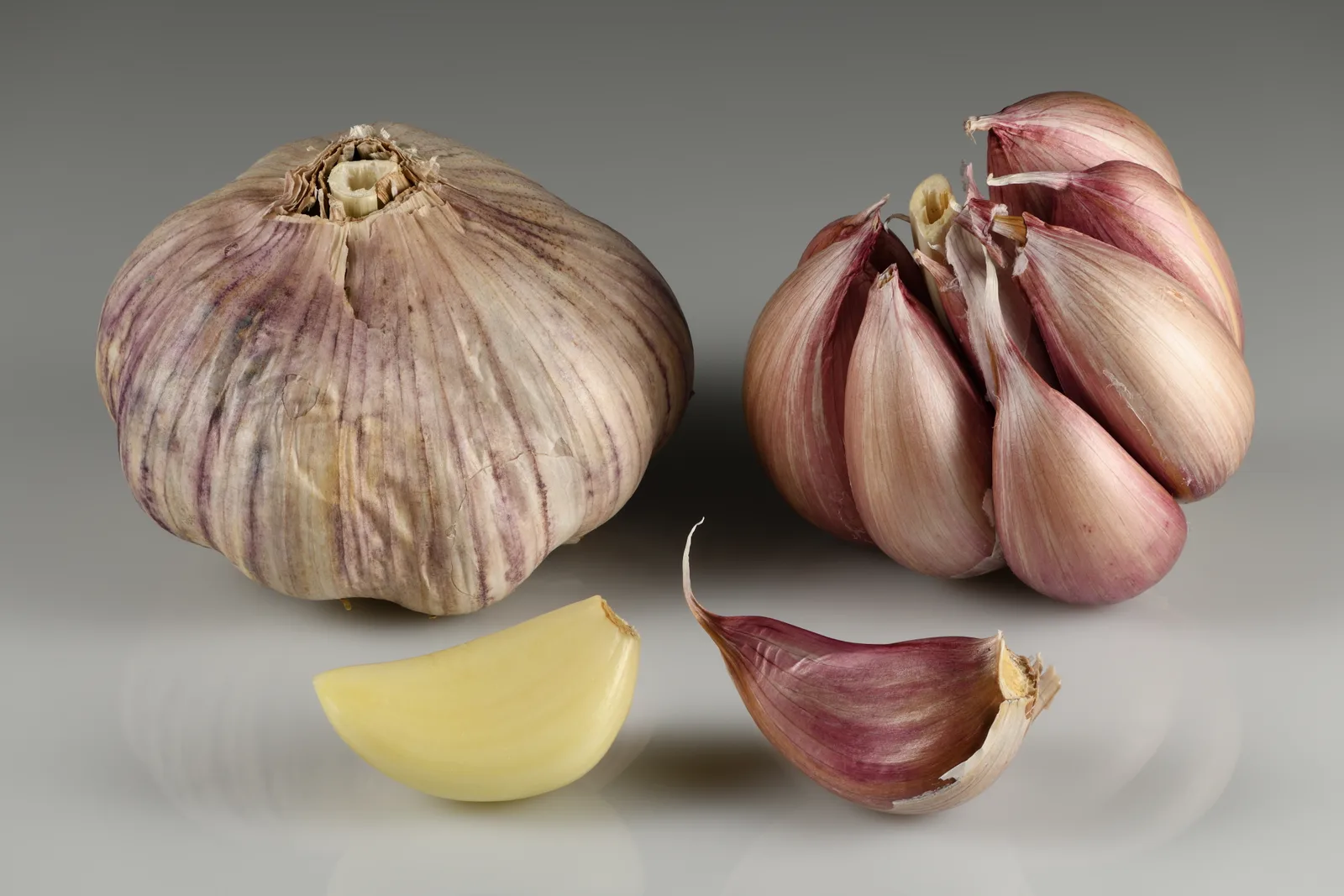
Plant the clove so there are about five centimetres of soil over the tip. In light, sandy soil you can go deeper, up to ten. Keep 10 to 15 centimetres between cloves and 25 to 40 between rows. A bulb gives 8 to 16 cloves, so a single bulb is enough for about a metre of row.
Give garlic a spot where onions, leeks or garlic have not grown for the last four or five years. Do not use fresh manure or fresh compost. Garlic wants rich, loose soil, but the manure should have had time to break down.
Warning: It is the wet and not the cold that kills garlic in winter. If water stands in the bed after autumn rain, the cloves rot. If you have heavy clay, plant garlic in a raised bed.
Is supermarket garlic any good?
Buy seed garlic. The garlic on the vegetable shelf is often grown in a warm climate and can carry white rot and viruses. White rot stays in the soil, and according to the Swedish seed company Impecta you then cannot grow onions in that spot for at least ten years. Some imported garlic is also treated to stop it sprouting. Seed garlic is inspected and untreated, and it is a variety chosen for your kind of climate.
That last part matters more the colder your winter. Most garlic sold for home growing in northern Europe is softneck, often French varieties like 'Germidour' and 'Messidrôme'. Softnecks keep for up to a year and can be braided. Hardneck garlic keeps only a few months, but many think it tastes better, and where winters are severe it is generally the safer choice. In Minnesota, the extension service warns that supermarket garlic, mostly softneck, does poorly there.
Harvest when about half the leaves have yellowed and started to flop, usually in July or August. Wait too long and the skin splits and the bulb falls apart. If the crop was healthy, you can keep the biggest bulbs and plant them next autumn. Then you do not need to buy new.
Sources
- University of Minnesota Extension, Growing garlic in home gardens. Planting one to two weeks after the first killing frost in a cold climate, and why supermarket garlic does poorly there.
- Royal Horticultural Society, Garlic. Autumn planting in Britain, the cold spell garlic needs to form a good bulb, free-draining soil, and no fresh manure.
- Impecta, Odla vitlök: guide för plantering och skörd. In Swedish. Roots but not leaves before winter, planting depth, why shop garlic is risky (white rot, virus, sprout inhibitors), crop rotation, and hardneck against softneck.
- Granngården, Odla vitlök på hösten. In Swedish. Soil around 8 °C, planting into December if the ground has not frozen, smaller bulbs and sometimes no cloves from spring planting, and splitting the bulb at planting.