Is it too late to plant tulips?
No, not as long as a spade still goes into the ground. Tulips do not need to root before winter, so it is frozen ground that sets the limit, not the calendar. In a mild, wet climate like most of Britain that means December, and in a mild year later still. Where winters are cold it usually means mid-November, and where they are long and hard, the end of September. If the ground has already frozen you can still plant the bulbs in a pot until the new year, and they will flower in spring anyway.
Gardian is a Swedish garden app, and in much of Sweden the ground freezes before half the tulips are in. So this question comes up every November, and the pot method below is the standard northern answer to it.
The tulip is the only one of the common spring bulbs that can wait this long. Daffodils, crocuses and hyacinths need four to six weeks with roots in the ground before it freezes, so if they are in the same bag, they are the ones that are late, not the tulips. The dates for every spring bulb, climate by climate, are in the article on when to plant bulbs.
How do you know if the ground is too frozen?
Push the spade in. If it goes through a frozen crust of a few centimetres into loose soil below, you are fine. A morning crust that thaws by lunchtime is no obstacle: plant in the middle of the day. If the spade hits hard soil all the way down, the ground has frozen, and it is time for the pot.
Plant the tulips as deep as usual, two to three times the bulb's height, in practice 12 to 18 cm (5 to 7 in). Shallow is tempting when the soil is cold and heavy to dig, but a shallow bulb gets lifted by frost over the winter and lies exposed in March. Dig one big hole and put twenty bulbs in it rather than twenty small holes.
If the soil has started to freeze at the surface, spread a layer of leaves or evergreen boughs over the planting afterwards. It keeps the ground open a few weeks longer and protects the bulbs from frost until the snow arrives.
What if the ground has already frozen?
Plant the bulbs in a pot. Any pot with drainage holes will do, and the bulbs can stand close together, almost shoulder to shoulder. Cover them with a few centimetres of compost, water once and put the pot somewhere cold but frost-free: an unheated garage, a root cellar or a shed against the house wall.
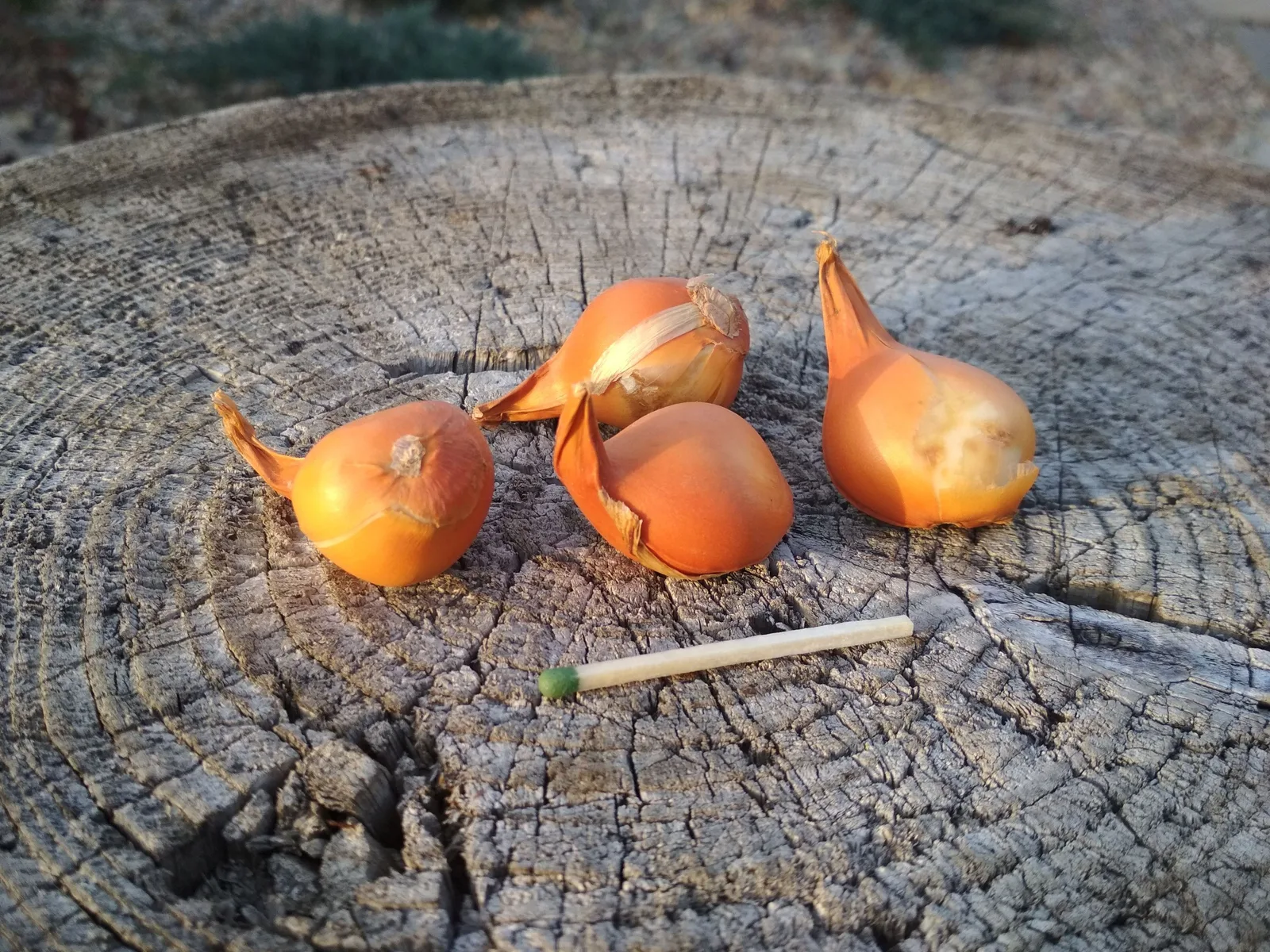
The cold is the whole point. A tulip needs 12 to 16 weeks at around 4 to 7 °C (40 to 45 °F) to form a flower, and that is exactly what a cold garage gives it. Do not water again until you see shoots in spring. Wet compost in the cold is what rots bulbs, not the cold itself.
Move the pot outside when the worst of the cold has passed, in March where winters are cold and April to May where they are long. Flowering comes a few weeks later than in the border and is often a little weaker the first year. Let the leaves yellow after flowering, then plant the bulbs out in the border, where they get an ordinary year next time.
Skip: Keeping the bulbs in the bag until spring. Without the winter cold you only get leaves, and most tulip bulbs have dried out long before next autumn.
Find a forgotten bag in January? Squeeze the bulbs. If they are still hard and heavy, the pot is worth a try. If they are light, soft or grey with mould, throw them away. How to find your own frost date is in the article on autumn garden jobs.
Sources
- Royal Horticultural Society, Bulbs: planting. Tulips planted in November, and the depth rule of two to three times the bulb's height.
- Iowa State University Extension, How do you force tulip bulbs indoors?. Tulips need 12 to 16 weeks at 40 to 45 °F.
- Wexthuset, Plantera vårblommande lökar sent på säsongen. In Swedish. That tulips can go in late, covering the planting when the ground has frozen, and the pot method until the new year.
- Fritidsodlingens riksorganisation, Plantera vårlökar. In Swedish. Planting depth, and which bulbs need to root before winter.
- SMHI (Swedish Meteorological and Hydrological Institute), Den första höstfrosten håller tidtabellen. In Swedish. Normal dates for the first autumn frost in Sweden, 1991-2020.
The dates by climate are our estimate of when the ground usually freezes, built on Swedish frost data and on RHS timing for mild climates. A mild year moves them by several weeks.