When should you hill up roses, and how?
Hill up your roses once the leaves have fallen and the top of the soil has started to freeze in the mornings, not before. Mound soil about 20 centimetres (8 inches) high round the base of the plant, so the graft and the lowest buds end up under soil. Those are what you are protecting, not the branches. Where winters are cold that usually means late October or November, and where they are long and hard, October. In a mild climate like most of Britain, most roses need no hilling at all.
Gardian is a Swedish garden app, and in Sweden hilling up is how most garden roses get through the winter. The habit is just as useful anywhere the ground freezes hard: the US Midwest and Northeast, Canada, central and eastern Europe.
Too early is worse than too late. Hill up while the soil is still warm and you seal damp and warmth round the base, and the rose gets mould instead of protection.
Why is it enough to protect the bottom?
Nearly every rose sold is grafted. The variety is budded onto a rootstock that takes far more cold than the variety on top. The join shows as a small knob just below the branches, and that knob is the rose's weak point.
If the branches freeze to the ground, the rose sends up new shoots from the buds under the soil and still flowers that summer. If the graft freezes, the variety dies. What comes up is the rootstock, and suddenly you have a wild rose with small, single, pale flowers where your border rose used to be. In Scandinavia the rootstock is usually dog rose, Rosa canina, which is what the photo below shows.
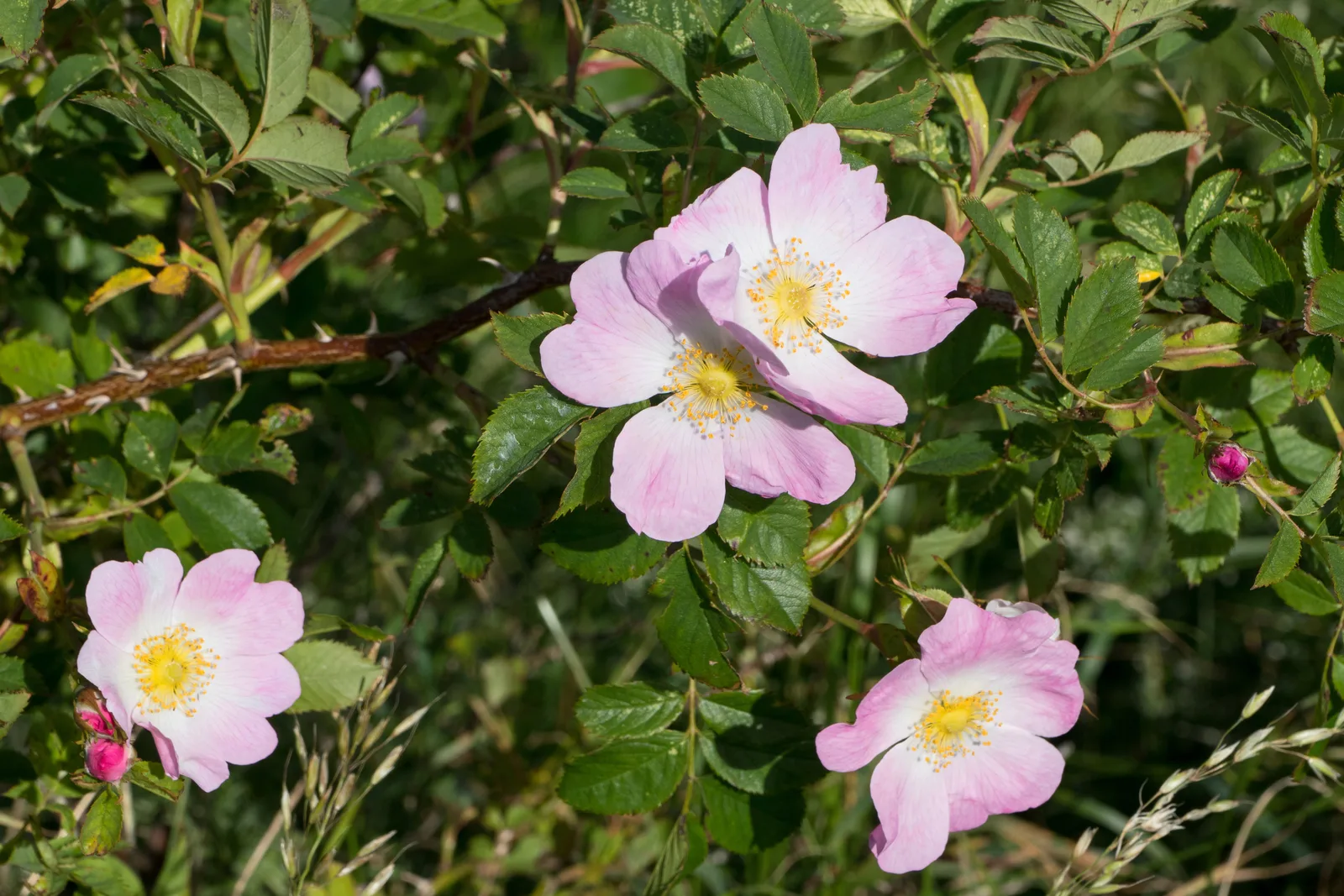
That is why, in a cold climate, the graft should sit 10 to 15 centimetres (4 to 6 inches) below the surface from the day the rose is planted. A container rose often has to go deeper than it stood in the pot. In a mild climate, at or just below the surface is enough. If you can see the knob above ground on a rose you already have, that is the one that needs hilling most.
What should you hill up with?
Ordinary garden soil or coarse compost. Take it from another part of the border or from a bag, not from round the rose's own base, because scraping up soil round the plant exposes the very roots you are trying to protect. Shape a mound that covers the bottom 20 centimetres of the branches.
Warning: Never hill up with peat. It soaks up water, freezes into a lump of ice round the plant and thaws so late in spring that the rose is still standing in a frozen block when the rest of the border has woken up.
Do not cut the rose back now. An autumn cut stays open all winter, and the pruning waits for spring. Once the cold has really arrived you can lay evergreen boughs over the bed. They shade the branches from the late-winter sun and hold the snow, which insulates better than anything you can buy.
Which roses need it, and when does it come off in spring?
Border roses need it most: hybrid teas and the large-flowered varieties, and climbers. Shrub roses, old garden roses and species roses are fairly tough and manage without, as long as they are hardy where you live. If a rose is at the edge of what it can take, hill it up whatever group it belongs to. The hardiness is on the label, and varieties differ a lot, even among climbers.
Hill up a climbing rose at its base like a border rose. Protect the branches on the trellis from sun and cold wind in late winter with hessian or evergreen boughs.
The standard (tree) rose is the exception. Its graft sits up at the top of the stem where the head begins, and no mound of soil reaches it. Wrap the head loosely in hessian, or bring a standard rose in a pot into a cool place for the winter, as described in the article on overwintering plants.
Take the mound away when the risk of hard frost is over, and do it the same day you prune: when the birch leaves are the size of a mouse's ear. Where there are no birches, forsythia in flower marks the same moment. Rake the soil out over the border, and it is in place for next autumn. The rest of the autumn work in the border is in the article on autumn garden jobs.
Sources
- Iowa State University Extension, How to overwinter roses. Mounding soil round the base of grafted roses in late autumn, with straw or leaves on top, in a cold climate.
- Zetas Trädgård, Plantering och skötsel av rosor. In Swedish. What hilling is and which roses it is for, the depth of the graft, hilling with border soil or coarse compost but never peat, evergreen boughs against late-winter sun, and when the cover comes off.
- Wexthuset, Planteringsråd för barrotade rosor. In Swedish. Dog rose as rootstock, and the graft about 10 centimetres below ground so hard frost does not damage it.
- Wexthuset, Beskärning av rosor. In Swedish. Pruning when birch leaves are the size of mouse ears, frost damage on cuts made too early, and where the graft sits on a standard rose.
- Malmö stad, Teknisk handbok: Rosor. In Swedish. Which groups of roses are tough and which are demanding.
The months by climate are our estimate from frost dates, not a figure from any of the sources.