How do you protect young trees over winter?
The cold is rarely what kills a young tree in winter. Voles do, gnawing the bark off round the trunk under the snow, and you only find out in April when the snow melts and the tree is already dead. Put a fine wire mesh guard round the trunk before the first snow, push it a few centimetres into the soil and run it well above the snow depth you usually get. That is the one protection you really cannot skip. The rest is about the late-winter sun and the weight of the snow.
Gardian is a Swedish garden app, and in Sweden the snow can lie for months, which gives voles a safe roof to work under all winter. Where winters are mild and snow rarely settles, voles still gnaw, but rabbits and deer usually do more of the damage. The same guard stops most of them.
What gnaws the tree, and how high should the guard go?
Voles are the most common culprit where snow lies. They move in tunnels under the snow, where it stays around freezing even when the air is minus 20, and eat the bark off the trunk in a ring from the ground up to 30 or 40 centimetres (12 to 16 inches). If the ring goes all the way round, the tree is dead, because the sap runs in the bark.
Hares and rabbits gnaw on top of the snow, and the snow lifts them. A guard that reached 80 centimetres up in autumn only reaches a hare's knees after 50 centimetres of new snow. In Britain, where snow is rare, rabbits are the main bark gnawers. Deer take buds and shoots, and in a hard winter they reach higher than you think.
What works against voles, rabbits and hares is the same thing: galvanised mesh with holes of 13 millimetres (half an inch) at most, rolled loosely round the trunk, pushed 5 centimetres into the soil and at least 80 centimetres high, or higher where the snow usually lies deep. US extension services use the same rule: guard the trunk higher than the snow you expect. Plastic spiral guards are sold everywhere and do the job against rabbits, but a vole gets in under a spiral that does not reach into the soil. Deer you only keep away with a mesh cage on three posts round the whole tree, at least 1.5 metres high, or with a 2 metre fence.
Two things make the guard work better. Mow the grass short in a ring of 50 centimetres round the trunk before winter, because voles avoid moving in the open. And tread down the snow round the trees after every big snowfall, so the tunnels under it get squashed.
Warning: Do not wrap the trunk in fleece or sacking and leave it. Voles like to nest in soft material right against the bark, and then you have built them a winter home at the dinner table.
The same voles take the tulip and crocus bulbs in the border, and how to protect those is in the article on when to plant bulbs.
Why does the bark split in late winter?
The sun warms the south side of the trunk on a clear day in late winter, the sap starts to move, and the night after, it freezes again. The bark splits in long cracks, often 10 to 20 centimetres long, and the wounds let in canker. In North America this is called sunscald or southwest injury. Young trees with thin, dark bark and newly planted trees that have not got used to their spot are most at risk.
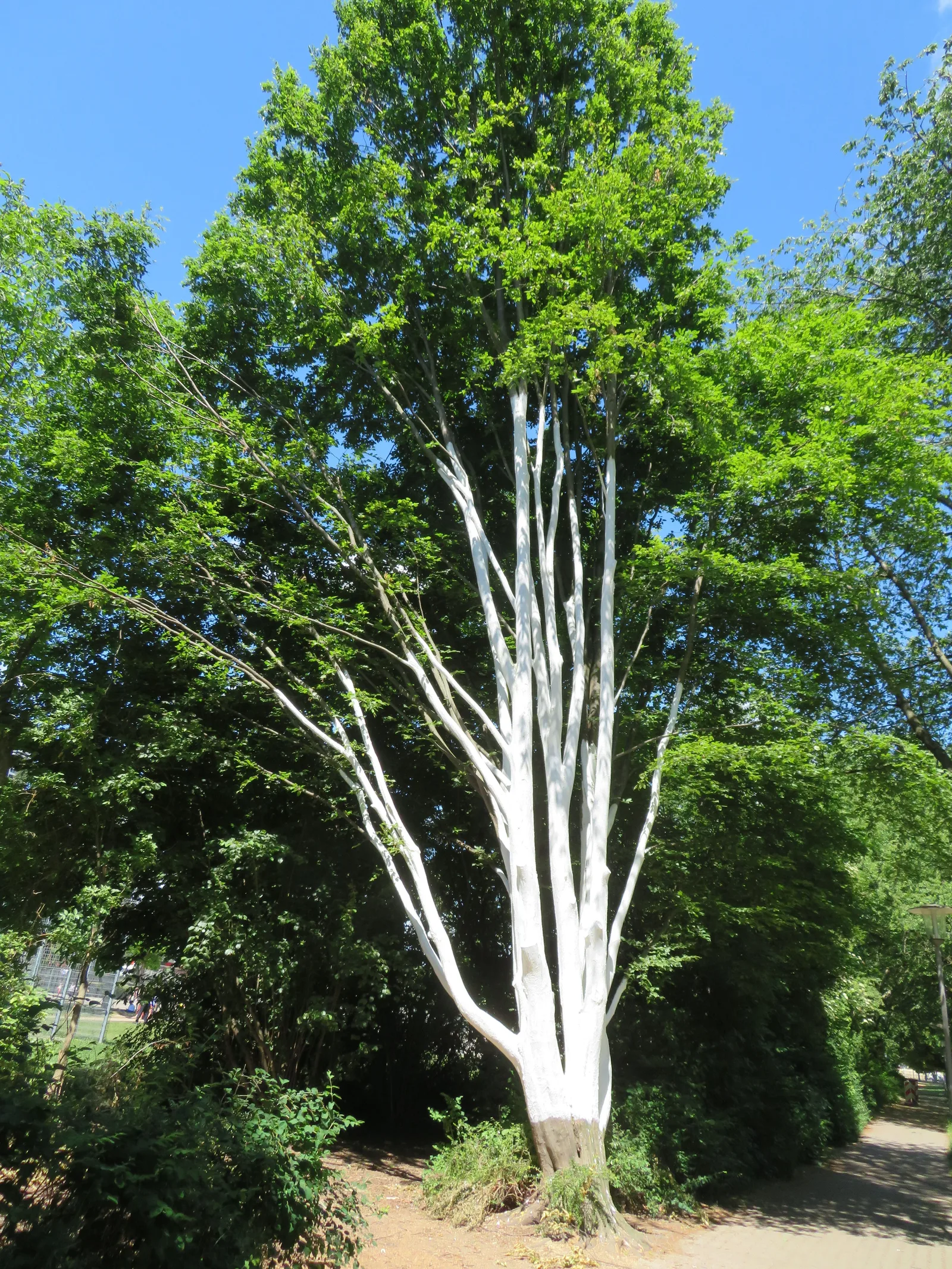
The protection is to make the trunk pale. In Scandinavia the traditional way is lime wash: mix slaked lime with cold water into a thick paste and paint the trunk from the ground up to the first branches. US extension services recommend white latex paint, diluted with water, which does the same job. A white surface does not take up the heat the same way, which is the same reason birch bark is white. The easiest time is the day you put the guard on in autumn, so it is done before the sun gets strong. A board leaned against the south side of the trunk works too. Where winters are mild and the late-winter sun weak, you can usually skip this step.
Do I need to do anything about snow and wind?
Check the stake. The tie that fitted last spring may have started cutting into a trunk that has grown, and over the winter it has time to do damage. Loosen it so the trunk can move a little, and take the stake away completely after 2 to 3 years, once the tree is anchored. Test by taking hold of the trunk and shaking it. If the root ball lifts in the soil, the stake needs another year.
Wet, heavy snow in a young crown breaks branches that dry powder never touches. Shake it off gently with a broom while it is fresh. Frozen snow you leave alone, or you break the branch yourself.
If the tree is newly planted it also needs water before the ground freezes, and how much is in the article on watering newly planted trees.
Sources
- University of Wisconsin-Madison Extension, Winter damage concerns for trees. Light-coloured trunk wraps against sunscald, and guarding trunks higher than the expected snow.
- University of Missouri Integrated Pest Management, It's a wrap. White latex paint on the lower trunk against southwest injury.
- Land, protecting trees from voles. In Swedish. Field voles and water voles, mesh size, and treading down the snow round the trees.
- Wexthuset, protecting plants from deer and wildlife. In Swedish. Methods against deer in the garden.
- Fruktträd i Norr, simple wildlife protection for young fruit trees. In Swedish. A mesh cage on three posts against hare, deer and elk.
- Krypfritt, voles and hares. In Swedish. How high the trunk guard should go and that it must reach above the snow.
- SMHI (Swedish Meteorological and Hydrological Institute), Snötäckets utbredning och varaktighet. In Swedish. When the first lasting snow usually comes across Sweden.
- SLU (Swedish University of Agricultural Sciences), degree thesis on winter damage to woody plants. In Swedish. How frost cracks form when the winter sun warms the trunk.
- Svenska äpplen, lime-washing fruit trees. In Swedish. Lime wash on the trunk and why the white surface protects.
- Stångby Plantskola, tree stakes. In Swedish. How long the stake should stay and how the tie should be loosened.