Does compost work in winter?
An ordinary garden compost heap stands still in winter, and that does no harm. Decomposition needs the material to stay above about 10 to 12 °C (50 to 54 °F), so it stops when the cold comes and picks up again when it goes. An insulated bin for kitchen waste can keep working all winter, but only if you keep filling it and it holds enough material to keep its heat. If it freezes anyway, keep filling it as usual. In spring it starts again by itself.
Gardian is a Swedish garden app, and in much of Sweden a compost bin is frozen from November to April. The advice below comes from municipal composting guides written for exactly that. In a mild climate the heap slows down rather than stops, and most of this applies only in a cold snap.
What happens in a garden compost heap in winter?
Nothing, and that is fine. Leaves, grass clippings and plant waste sit there and wait. Freezing ruins nothing, and the material breaks down just as well as before once the warmth comes back. In a mild, wet climate the heap keeps working slowly through most of the winter. Where winters are cold it thaws during mild spells and works a little at a time. Where they are long and hard, it is frozen from the first deep frost until the ground thaws.
What matters is what you do before winter. Fork the material over from the first bay into the second, water it if it is dry, firm it down and cover it with straw or leaves. What to do with the autumn leaves is in the article on leaf mould.
Keep adding garden waste over winter. The heap takes it, even when it is frozen.
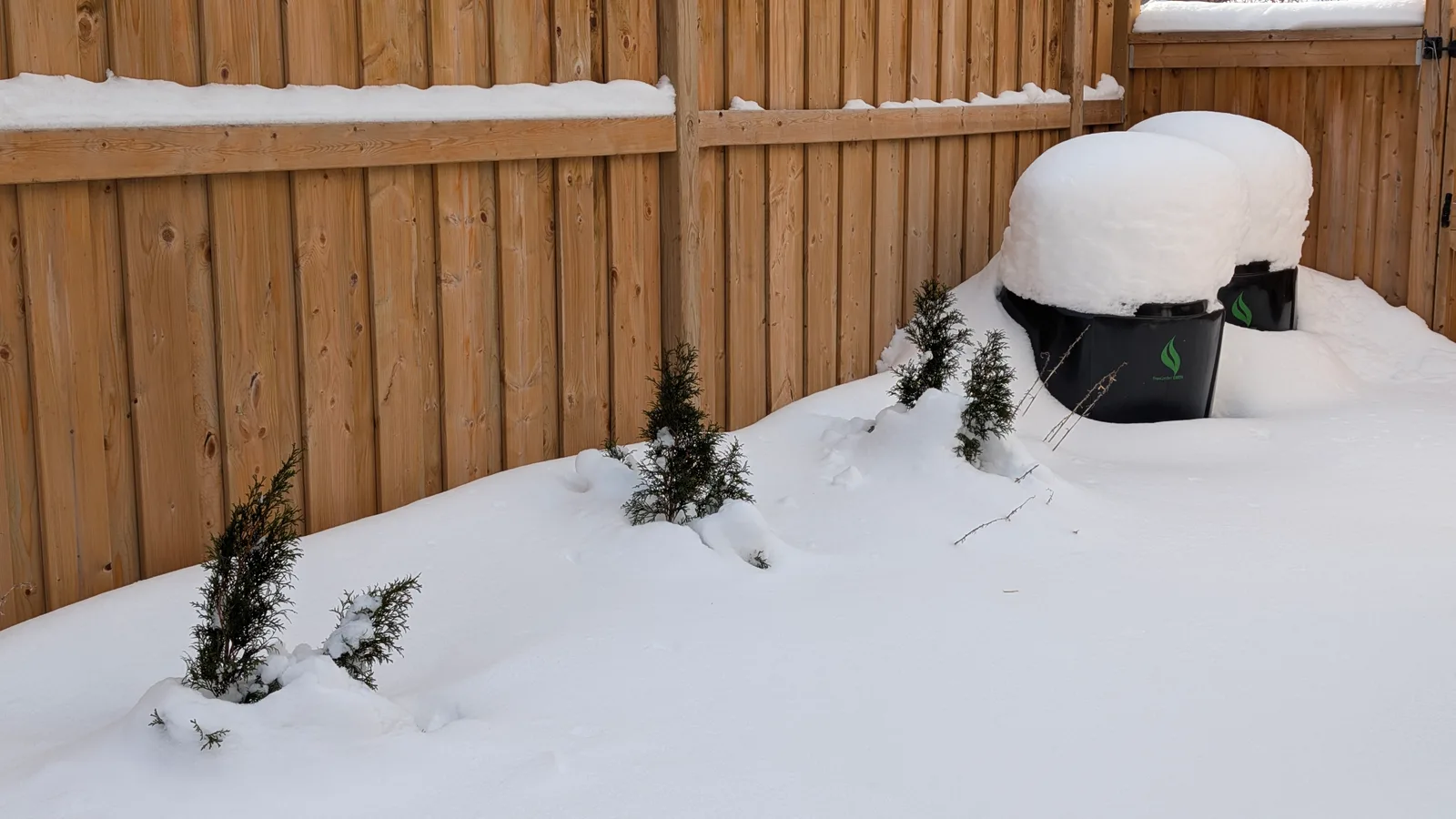
How do you keep a kitchen-waste compost going?
With insulation and with mass. A kitchen-waste bin that is going to work in winter has to be insulated, and it has to be full. A compost that is working properly runs at 50 to 70 °C (120 to 160 °F) inside, and it is the amount of material that holds that heat. So do not empty it in autumn. It is the half-empty bin that freezes first.
Add bulking material every time you empty the caddy, roughly one part to three or four parts food waste, and more if the compost turns wet or smells. Bulking material is something dry, such as wood shavings, wood chips, shredded straw or dry leaves, and it gives the compost air and soaks up moisture. Keep it dry in a lidded bin next to the compost. Damp material freezes into a lump. On a cold morning it is enough to mix the food waste with the bulking material in the caddy indoors, in the warm, before you take it out.
Do not stir it in winter. Every time you mix the whole mass you let the heat out. Just loosen the top 20 to 30 cm (8 to 12 in) a couple of times a month, and move material from the edges towards the middle, where it is warmest.
If the compost has started to cool, you can push a plastic bottle of hot water into the material. It sounds like an old wives' trick, and it is, but it works for getting a compost that is about to stall going again. Banking snow round the bin helps too, but not over the lid, where the air needs to get in.
What do you do if it has already frozen?
Keep filling it as usual, with bulking material. A long, hard cold spell can freeze even an insulated bin, especially if there is too little in it. That is not a fault and does no damage, and the compost gets going again when the weather warms.
Skip: Hacking at a frozen compost to mix it. All you do is let out the little warmth that is left.
Expect it to be wet in spring. When a whole winter's food waste thaws at once it releases a lot of liquid, so keep extra bulking material to hand and mix it in well when the time comes.
Winter is also when rats go looking for food. The bin should be tight enough that gaps and holes are no more than a few millimetres (an eighth of an inch), and that matters as much in January as in July.
If you want to start a new compost, wait for spring. In winter there is too little material for the process to build up any heat, and a new compost freezes before it gets going.
Sources
- Royal Horticultural Society, Composting. Composting slows down over winter, and a good bin keeps out rain and holds some warmth.
- SÖRAB (a Stockholm waste authority), Råd för kompostering av hushållsavfall. In Swedish. Decomposition needs more than 10 to 12 °C, how much bulking material food waste needs, an insulated bin for year-round use, and the bottle of hot water.
- Rosk'n'Roll (a Finnish waste company), Komposteringsguide. In Swedish. Bulking material in every layer, no stirring in winter, filling a frozen bin as usual, and spring as the best time to start.
- Koloniträdgårdsförbundet (the Swedish allotment federation), Lätt om odling nr 13: Kompostera trädgårdsavfallet. In Swedish. Turning the heap between bays in autumn and covering it with straw or leaves over winter.
- Svenska Yle, Kompostering, från mat till mylla. In Swedish. The temperature of a working compost, snow round the bin as insulation, and why a new compost should not be started in winter.