Which plants survive in a winter pot outdoors?
Choose plants that are hardy outside and pack them in tight, because nothing grows in a winter pot. It looks in February exactly as it did the day you planted it. Bud-flowering heather, skimmia, ivy, gaultheria and evergreen cuttings last all winter. Cape heath, the one with tiny pink or white bells crowded along the stems, Erica gracilis, sits on the same shelf in October, but it is a South African pot plant that cannot take being frozen. It lasts until the first hard frost. In a mild climate that might be January or never. Where winters are cold, it is gone by the end of autumn.
Gardian is a Swedish garden app, and a Swedish front-door pot has to get through weeks of frost and snow without growing a leaf. So the advice here is built for a winter that freezes the pot solid. Where winters are mild you have more to choose from, but the plants below work anywhere.
Which plants last all winter?
Bud-flowering heather (Calluna vulgaris, varieties such as 'Garden Girls') is the backbone of most winter pots. The flowers never open, so the buds keep their colour all winter instead of fading. Do not let it dry out before it freezes. Heather that freezes dry turns brown and does not come back.
Skimmia has red buds or berries and dark green leaves. It wants shade or part shade and shelter. By a north-facing door it does better than in full sun, where the winter sun scorches the leaves.
Ivy gives you something to trail over the edge. Buy it from the outdoor plants, not the small-leaved type from the houseplant shelf. There are many varieties, and those grown for indoors take far less cold.
Gaultheria has glossy leaves that turn reddish in the cold and red berries that last until spring.
Evergreen cuttings, pine cones and birch twigs fill the gaps. Cut material lasts all winter in the cold, and it is cheap or free.
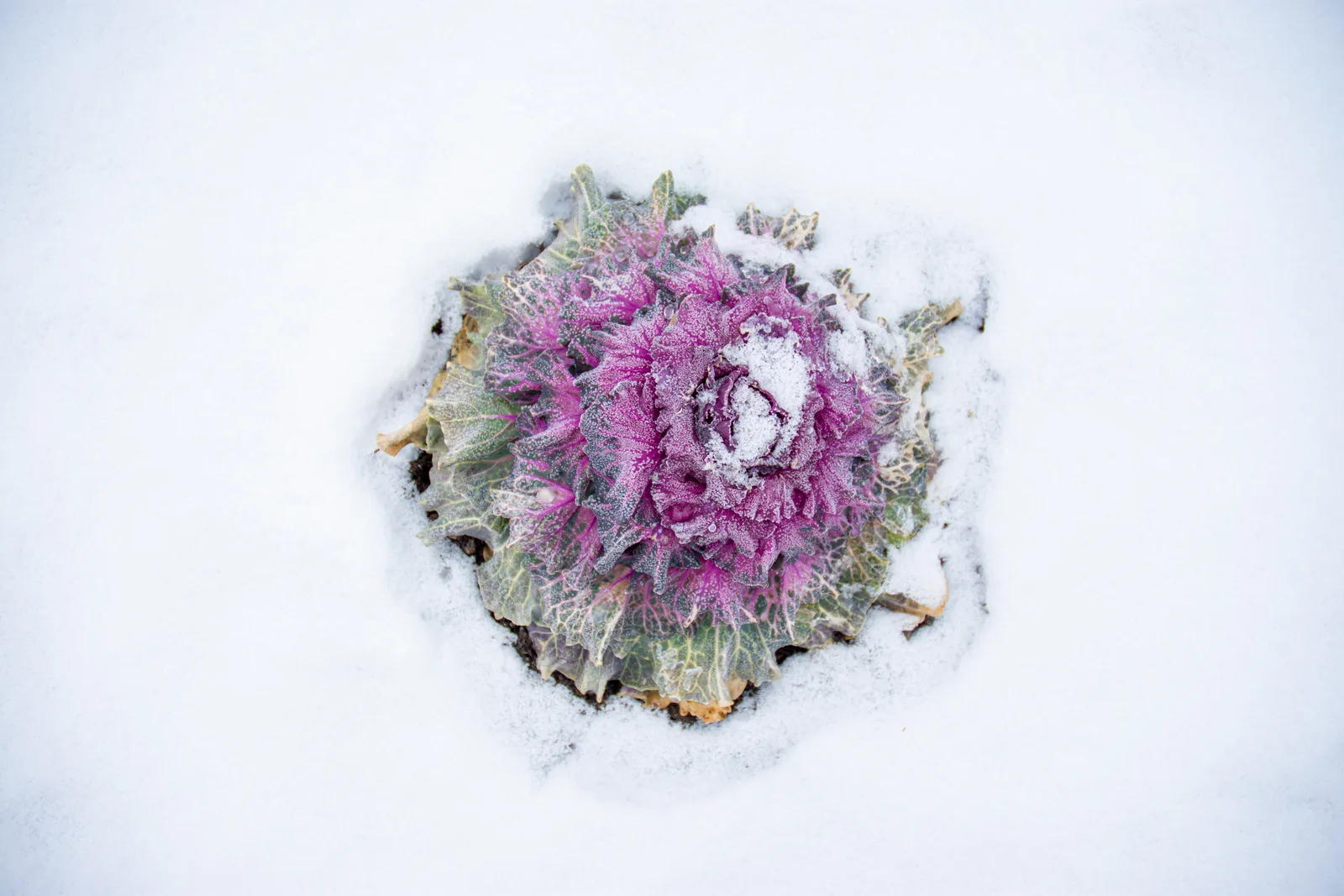
Ornamental cabbage is the most common disappointment. It takes frost and looks good in the snow, but after a few rounds of freezing and thawing it turns slimy. Count on it until Christmas, and swap it for evergreen cuttings when it starts to collapse.
Why do plants struggle more in a pot than in the ground?
In a border, the roots are protected by the soil around them. In a pot, the compost freezes from every side, and the roots are the part of the plant that tolerates the least cold. So choose plants rated hardy to one zone colder than where you live. If your garden is in USDA zone 6, buy plants rated to zone 5.
Use a big pot, at least 30 cm (12 in) across. More compost freezes more slowly. Stand the pot close to the house wall, where it is a few degrees warmer, and preferably grouped with others.
Water the winter pot. It sounds wrong in December, but evergreens lose water through their leaves all winter and cannot take any up from frozen compost. Water well before it freezes hard and then on mild days when the compost has thawed. Drought kills more winter pots than cold does. In a wet, mild climate, check instead that rain is not standing in the pot.
Skip: Feeding. Nothing in the pot grows before spring.
Will the pot crack in the frost?
That depends on what it is made of and what the label says. A frost-resistant pot can stand empty outside through winter. With wet compost in it, the compost freezes, expands and cracks the pot from the inside. For a winter pot it has to be frost-proof. Terracotta without that label usually cracks in its first winter.
The pot needs drainage holes, and it should stand on pot feet a few centimetres (an inch or two) off the ground so the water can run away. Put a couple of centimetres (an inch) of clay pebbles in the bottom.
One trick solves both the frost and next season: plant into an ordinary plastic pot and stand it inside the good one. The outer pot has no wet compost to freeze and burst it, and in spring you just lift out the whole plastic pot and drop in one with spring bulbs instead.
Sources
- Royal Horticultural Society, Erica gracilis. Hardiness rating H2, tolerant of low temperatures but not of being frozen.
- Plantagen, Köpa utekrukor, tänk på det här. In Swedish. Frost-resistant and frost-proof pots, drainage holes, clay pebbles, and choosing plants hardy to a zone colder than where you live.
- Svenska Yle, Uthuset på Strömsö: höstväxter och dekorativ belysning. In Swedish. That heather should not dry out before the frost, skimmia lasting all winter and ornamental cabbage not lasting long.
- TV4, Trädgårdstips: Så får du växterna att klara vintern. In Swedish. That the roots are the sensitive part of a plant in a pot, and that ivy comes in more and less hardy varieties.
- Bygghemma, Höstblommor ute, så lyckas du med din höstplantering i kruka. In Swedish. Ivy, heather and ornamental cabbage in autumn pots, and watering when the compost feels dry.