When should you start feeding birds in winter?
Start when the cold comes and the food in the wild runs out, and carry on until the ground is bare and the insects are back in spring. In Britain the RSPB puts that at November to April for seed and peanuts, and where winters are long the season starts earlier and ends later. Sunflower hearts and fat are all the birds really need. What decides whether you are helping them or harming them is how clean the feeder is, because disease spreads exactly where many birds gather.
Gardian is a Swedish garden app, and in Sweden feeding birds through the winter is close to a national pastime: several hundred thousand households do it. The advice below draws on Swedish vets and on the RSPB, and where they differ, it says so.
What should the birds get?
Sunflower hearts are eaten by almost every species at the feeder, and with the husks already gone there is no mess under it. That means fewer rats, and no black carpet of husks on the lawn in spring.
Fat is the most energy-dense food you can give. Suet, lard or coconut fat all work, preferably melted and poured into half a coconut shell. Shop-bought fat balls work too, but in a hard frost they set like stone and the birds can hardly get anything off them. Crumble them when it is at its coldest.
Peanuts go in a metal mesh feeder, never loose. Robins pick up the crumbs that fall.
Cheap seed mixes are often mostly wheat and oats, which the birds flick out of the feeder to get at the sunflower seeds. On salt the advice differs. The RSPB says to avoid anything salted. Swedish vets are relaxed about a little salted butter or ordinary peanut butter. Unsalted costs nothing extra, so there is no reason to test it.
Warning: Cut the plastic mesh off fat balls before you hang them up, or buy them without. Birds catch their feet in it.
How do you avoid spreading disease?
Disease at feeders peaks in late winter. In Sweden it is mostly salmonella, and it hits the finches hardest: bullfinch, siskin, redpoll and greenfinch. In Britain trichomonosis, which has killed huge numbers of greenfinches, is the other one to know about. Both spread through droppings or saliva that end up in the food and water, which is why a bird table, where the birds stand in the food, is worse than a tube feeder where they can only reach the seed through a hole. The RSPB advises against flat feeders altogether.
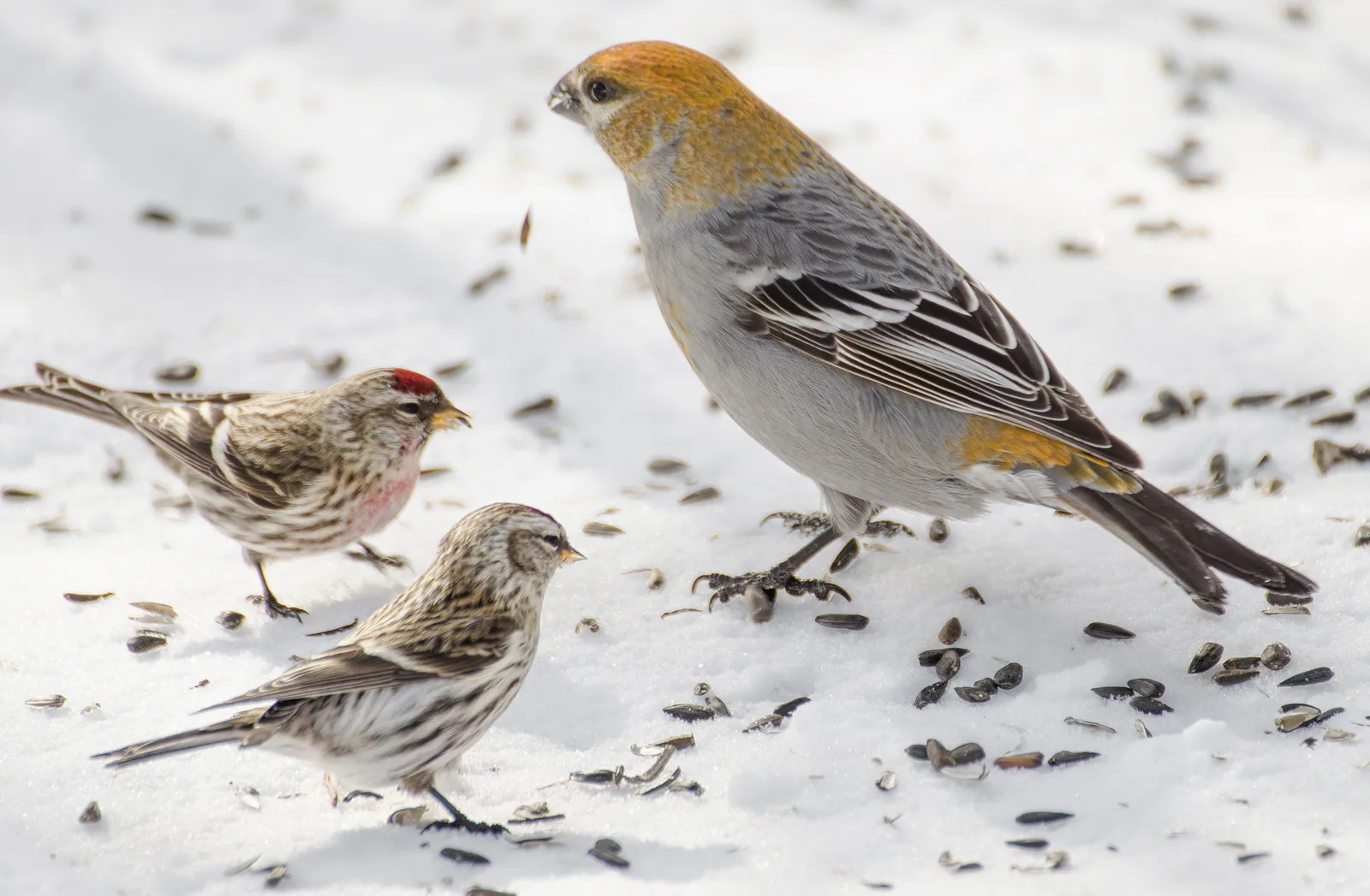
What makes the most difference:
- Use tube feeders and hanging feeders instead of open bird tables.
- Put evergreen boughs under the feeder, so seed that falls ends up out of reach instead of on bare ground where birds feed on it.
- If you feed on the ground, move the spot often so the same patch is not used all winter.
- Clean the feeders every week, the RSPB says, with hot water and a mild disinfectant, rinse them, and let them dry before refilling. Wear gloves and wash your hands afterwards. Cats can catch salmonella too.
A sick bird sits still and fluffed up and does not fly off when you come close. If you see birds like that at the feeder, stop feeding altogether. Swedish vets say at least three weeks, the RSPB says four. Clean everything and start again in a new spot. In Britain you can report sick or dead garden birds to Garden Wildlife Health, and in Sweden to the national veterinary institute, SVA. Wear gloves if you handle them.
Does it matter if you stop feeding?
No. Birds do not sit and wait at an empty feeder. If the food runs out at yours, they move on to other places, and there are plenty of them. You do not need to feel guilty for feeding for only a few weeks, or going away over Christmas.
Feeding does make a difference on a larger scale. In Sweden it is part of the reason blackbirds increasingly spend the winter instead of migrating, and why robins take the chance to stay on in the far south.
If you have a feeder running in late January, you can take part in a garden bird count: the RSPB's Big Garden Birdwatch in Britain, or BirdLife Sverige's Vinterfåglar inpå knuten in Sweden. You count the birds at your own feeder during the count and report the highest number of each species you see at once.
Sources
- RSPB, How and what to feed your garden birds. Seed and peanuts paused from May to the end of October, no mesh bags, feeders out of reach of cats, no flat surfaces, and salted food to avoid.
- RSPB, Feeding birds near you. Trichomonosis, weekly cleaning with mild disinfectant, and stopping feeding for four weeks if sick birds appear.
- Garden Wildlife Health, Garden Wildlife Health. Reporting sick or dead garden wildlife in Britain.
- Sveriges Radio, Frågor och svar om fågelmatning. In Swedish. The vet Lotta Berg on food, fat, salt, the mesh round fat balls, cleaning, sick birds and a break of at least three weeks.
- SVT Nyheter, SVA varnar: Småfågeldöd breder ut sig. In Swedish. Salmonella in bullfinches, redpolls and greenfinches, evergreen boughs under the feeder, gloves, and infection in cats.
- Studiefrämjandet, Frågor och svar: Mata fåglar. In Swedish. Fat balls working poorly in hard frost, and food for robins.
- TV4, Fågellarmet: Utan matning riskerar de att dö. In Swedish. BirdLife Sverige on how many households feed birds, overwintering blackbirds and seed mixes.